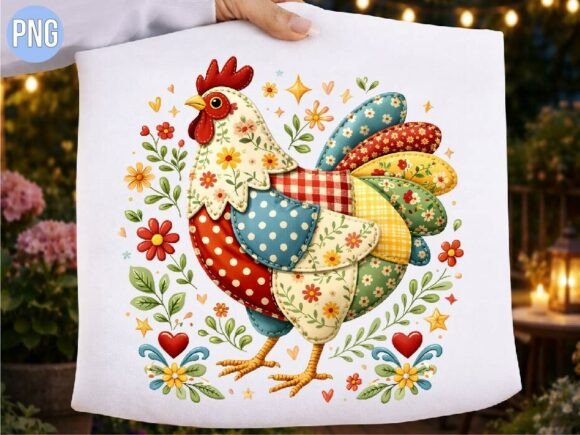
Faux Embroidery Rooster Floral Craft PNG
A Designer’s Real-World Review for Small Business Merchandise
As an embroidery designer who’s digitized over 2,000 logos and crafted branded patches for cafés, florists, bakeries, pet brands, and handmade studios, I approach every digital embroidery file with two questions: Will it stitch cleanly on real fabric? and Will it strengthen my client’s brand—not distract from it? When I first saw the Faux Embroidery Rooster Floral Craft PNG, my instinct was cautious optimism. The title signals a specific visual language—rustic charm meets artisanal detail—and the description confirms it’s built for versatility across creative projects. But “versatile” doesn’t automatically mean “business-ready.” Let’s break down how this design performs where it counts: on uniforms, patches, totes, caps, and product labels.
First Impression: Handmade Warmth with Clear Brand Personality
The Faux Embroidery Rooster Floral Craft PNG lands as warmly professional—not overly playful, not stiffly corporate. It balances boldness (the rooster’s confident posture) with delicate nuance (floral accents, implied stitch texture). That duality makes it ideal for small businesses that want to signal authenticity without sacrificing polish. A local florist can use it on aprons and tote bags to reinforce craft and care; a heritage bakery might place it subtly on sleeve cuffs or packaging tags to evoke tradition and freshness. It reads as handmade product, not mass-produced clip art—critical when your customers choose you for personality, not price.
Where It Shines in Commercial Embroidery Projects
- Embroidered patch: Works beautifully at 2.5"–3.5" sizes. The rooster’s silhouette holds definition, and floral elements translate well into satin-stitch fills and gentle stem stitches—no fragile micro-details that vanish under thread.
- Apron embroidery: Perfect for chest placement on denim or canvas. Its balanced proportions avoid visual heaviness while offering enough presence to act as a signature mark—not just decoration.
- Cap embroidery: Clean lines and moderate density make it adaptable to front-panel cap hoops. Avoid stretching the design beyond 2.25" width to preserve legibility on curved crowns.
- Tote bag design: Scales well to 4"–5" when stitched on cotton duck or canvas. The faux-embroidery texture enhances perceived value—customers see craftsmanship, not print.
- Staff uniforms & work shirts: Subtle enough for daily wear, distinctive enough to unify teams. Pair it with minimalist monogramming for layered brand consistency.
- Product packaging accents & boutique merchandise: Use as a sewn-on label on linen pouches, ceramic jar tags, or woven hangtags—reinforcing handmade credibility at point of sale.
Where Caution Is Essential
Not every surface is forgiving—and the Faux Embroidery Rooster Floral Craft PNG has limits worth honoring. On dark uniforms, confirm thread color contrast early: light ecru or mustard gold may get lost on navy or charcoal without a white underlay. On textured fabrics like bouclé or heavy twill, test stabilizer choice—medium-weight cutaway prevents puckering around dense floral zones. Avoid scaling below 1.75" for patches or cap fronts; fine stems and inner rooster details risk merging or skipping. Also, steer clear of high-wear items like chef jacket pockets unless stitch density is verified low—excessive density increases abrasion risk during frequent laundering.
Brand Identity Impact: More Than Just a Logo
This isn’t just a T-Shirt Designs graphic—it’s a brand amplifier. When stitched onto a café’s barista apron, it tells customers: We’re rooted, we’re proud, we pay attention to detail. When repeated across tote bags, caps, and product jars, it builds visual consistency without monotony—thanks to its organic shape and balanced negative space. Unlike generic vector icons, the Faux Embroidery Rooster Floral Craft PNG carries implied technique and intention. That perception lifts perceived product value and fosters trust—especially among shoppers who prioritize story-driven, locally made goods. For Etsy sellers and handmade brands, that subtle credibility edge converts browsers into loyal buyers.
Practical Notes Every Embroidery Designer Should Apply
- Test in black and white first. Confirm silhouette clarity before committing to thread palettes.
- Check small-patch viability. Resize to 1.75" and inspect spacing between rooster comb and nearest flower—tight gaps may collapse in stitching.
- Review thread color contrast against your client’s fabric swatches—not just on screen.
- Inspect spacing and underlay in your embroidery software. Does the design include jump stitches optimized for commercial machines? If not, adjust.
- Confirm hoop size compatibility. Most standard cap hoops fit up to 2.5" wide—verify the design fits within those constraints before digitizing.
- Test on real fabric with correct stabilizer. A 3"x3" sample reveals how floral fill stitches interact with grain and texture.
- Create a printable mockup for client approval—show it stitched on actual garment photos, not flat vectors.
- Compare beside other design assets. Does it harmonize with existing logos, fonts, or brand colors—or create visual dissonance?
- Confirm commercial licensing before production. The description states it’s “for a wide variety of creative and Print on Demand projects,” but always verify usage rights for resale, distribution, or large-batch embroidery runs.
Final Thought: A Strategic Asset, Not Just a Graphic
The Faux Embroidery Rooster Floral Craft PNG isn’t merely a Graphics file—it’s a scalable brand element designed to live across touchpoints. Used intentionally, it supports storytelling, reinforces quality cues, and helps small businesses stand out in crowded markets. Whether you're an embroidery shop quoting a boutique launch, an Etsy seller building cohesive merch bundles, or a café owner refreshing staff gear, treat this design as a working partner—not just a pretty image. Respect its structure, test its behavior, and align it with your client’s voice. That’s how a single digital embroidery file becomes part of a memorable, trustworthy, and unmistakably human brand experience.