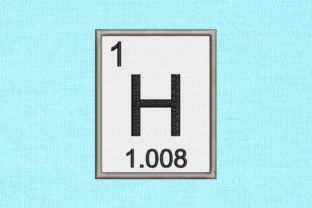
Periodic Element 1 Hydrogen Applique
A Seasonal Embroidery Designer’s First Look
As an embroidery designer who builds seasonal collections for real holiday shoppers—not just science teachers—I opened Periodic Element 1 Hydrogen Applique expecting clean, confident minimalism. What I found was a quietly joyful design: crisp lettering for “H”, the atomic number “1” set with balanced spacing, and subtle structural hints of the periodic table grid—enough to signal “science” without overwhelming the eye. It reads as modern, approachable, and warmly intelligent—not clinical or academic. That tone is gold for holiday use: it fits STEM-loving kids, curious teens, proud lab techs, new parents naming babies after elements, and educators gifting themselves something meaningful. It’s not festive in a glittery sense—but it *is* festive in the way thoughtful, personalized gifts are: warm, intentional, and quietly celebratory.
Holiday-Ready Applications Across Your Product Line
This machine embroidery design shines where personality meets practicality. On sweatshirt embroidery, it anchors a left-chest placement beautifully—small enough for youth sizes, bold enough for adult hoodies. As a tote bag design, it adds quiet wit to farmers’ market hauls or teacher appreciation kits. For kitchen towel embroidery, it pairs perfectly with linen or cotton terry—especially when stitched in soft heather gray or navy thread against cream fabric. As a pillow cover motif, it elevates minimalist home decor without shouting. And yes—it works on ornaments and embroidered patches too: small-scale, stable, and instantly recognizable even at 2 inches tall.
For handmade gift sellers, Periodic Element 1 Hydrogen Applique slots effortlessly into bundles: pair it with “Oxygen” and “Carbon” designs for a “Life Elements” trio; layer it on baby onesies with tiny stars for a “Little Scientist” newborn set; or stitch it onto aprons alongside chalkboard-style recipe labels for a chemistry-themed kitchen collection. Etsy sellers will find it performs well in social media previews—clean lines render crisply in thumbnails, and its meaning sparks engagement (“Wait—is that hydrogen? My daughter’s doing her first science fair!”). In craft fairs, it stands out among floral or rustic motifs by offering smart, gender-neutral charm.
Where to Use It Thoughtfully—Not Everywhere
While versatile, this digital embroidery file has boundaries worth honoring. Avoid it on curved caps unless you’ve confirmed hoop compatibility and digitizing flexibility—the geometry can distort fine lettering. Skip it for tiny hoop sizes under 3.5 inches unless you’ve tested how the atomic number “1” holds up at scale; small details may blur on dense fabrics like thick towels or fleece. On dark fabric, test thread colors carefully: white or light silver can look elegant, but avoid pale yellow—it risks reading as dingy. Metallic thread? Not recommended here—this design relies on precision, not shimmer. And for stretchy garments (think lightweight knits), reinforce with cutaway stabilizer and reduce stitch density if your file allows adjustment. Always confirm commercial licensing before selling finished seasonal products—this isn’t just best practice; it’s essential for small shop product integrity.
Why It Elevates Holiday Appeal—and Buyer Trust
Periodic Element 1 Hydrogen Applique boosts perceived value because it feels curated, not generic. Buyers recognize intentionality: this isn’t clipart slapped on fabric—it’s a considered seasonal embroidery piece with emotional resonance. That builds trust, especially during high-stakes holiday shopping. A parent buying a personalized gift for their budding chemist wants authenticity, not cliché. A teacher ordering class sets appreciates designs that reflect real classroom identity—not just school spirit slogans. Visually, its clean structure ensures instant recognition across mockups, printable promotional graphics, and Instagram carousels. It supports brand consistency for shops leaning into “thoughtful handmade” positioning—no need to over-explain; the design speaks for itself.
Practical Designer Notes Before You Stitch
- Test thread colors on both light and dark fabric swatches—especially for the symbol “H” and numeral “1”.
- Check stitch density: if the file feels heavy for lightweight linens or baby items, consider reducing density or opting for a lighter fill version.
- Confirm hoop size compatibility early—don’t assume it fits standard 4x4 unless verified.
- Match stabilizer to fabric texture: tear-away for stable wovens, cutaway for knits or towels.
- Create realistic printable mockups showing it on actual holiday-use items—sweatshirts, pillow covers, tote bags—not just blank hoops.
- Review small details post-stitch: does the “1” read cleanly? Are edges sharp on curved applique edges?
- Plan cohesive color palettes: think deep indigo + slate gray, or warm oat + terracotta—colors that feel seasonal, not sterile.
- Verify commercial embroidery rights before listing finished goods—especially for holiday drops with tight timelines.
Final Thought: Science Meets Seasonal Heart
In a season crowded with reindeer and snowflakes, Periodic Element 1 Hydrogen Applique offers something rare: quiet confidence, intellectual warmth, and genuine versatility. It’s not just a school design repurposed for holidays—it’s a holiday embroidery asset built for meaning, wearability, and real-world production. Whether you’re an Etsy seller launching a “STEM & Sparkle” collection, a craft fair vendor curating cozy-cool home goods, or a small-batch apparel decorator building family-matching sets, this embroidery file earns its place—not as filler, but as a thoughtful anchor. Showcasing love of science really *is* elementary. And sometimes, the simplest element makes the strongest impression.